

While researching mutual fund strategies, you may come across the term "momentum fund." To simplify, the strategy of momentum funds resembles wagering on the fastest runner. These funds focus on selecting stocks that are already performing well, with the expectation that these top-performing stocks will maintain their success in the short to medium term. In this blog, we provide valuable insights to help you determine if momentum funds align with your investment goals and risk appetite.
WHAT IS A MOMENTUM FUND?
A straightforward definition of Momentum Funds is that they are a particular category of mutual funds that focus on investing in stocks that have shown upward price movement over a certain timeframe. The underlying concept is that stocks that have recently done well are expected to continue their positive performance.
These funds rely on the concept of market momentum, which suggests that investor behaviour tends to follow trends. When a stock shows strong performance, more investors are likely to buy it, pushing the price even higher. Conversely, stocks that are losing momentum may be avoided.
While they can capture fast-growing opportunities, momentum funds can be more volatile than traditional diversified funds. Fund managers continually monitor market trends and adjust holdings to ride upward momentum.
In essence, a momentum fund is designed for investors looking to capitalize on market trends rather than buy-and-hold stability. It’s particularly appealing for those who can tolerate short-term volatility for the chance of higher returns.
WHY CONSIDER MOMENTUM FUNDS?
Momentum funds can be appealing for several reasons:
- Potential for Higher Returns: They tend to perform well in bull markets.
- Active rebalancing to chase trends.
- Diversification: Not just market cap-based.
- Ideal for Risk-Takers.
- Focus on recent winners.
- Short to medium-term horizon.
- Quantitative analysis over fundamental research
- May be actively or passively managed
MOMENTUM FUND VS TRADITIONAL FUNDS
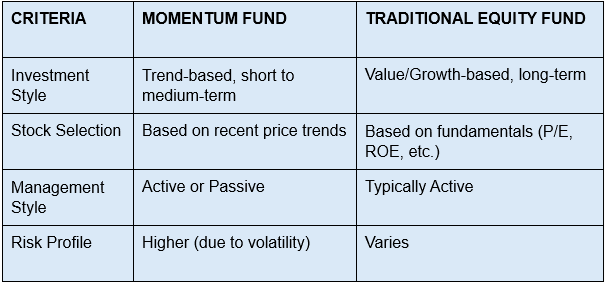
CONDITIONS FAVOURING MOMENTUM FUND PERFORMANCE
1. Sustained Bull Markets:
In a consistently rising market, momentum funds have a higher chance of capitalizing on stocks that continue to perform well, allowing investors to ride gains.
2. Clear Sectoral Leadership:
When specific sectors are driving market returns, momentum funds can quickly adjust their focus to align with these leaders, maximizing potential gains in those areas.
3. Post-Correction Recoveries:
After market pullbacks, certain stocks often rebound more sharply. Momentum funds are structured to capitalize on these rebounds, benefiting from rapid recovery trends.
Understanding these ideal conditions can help you set realistic expectations for momentum funds, which generally thrive in these scenarios.
CONDITIONS LEADING TO MOMENTUM FUND UNDERPERFORMANCE
1. Highly Volatile or Sideways Markets:
In environments characterized by erratic price movements, momentum funds may struggle due to frequent reversals, resulting in higher turnover and reduced returns.
2. Early Bear Market Phases:
Momentum strategies typically lean on recent winners. When these trends reverse, those formerly strong stocks can suffer significant losses, leading to underperformance for momentum funds.
By recognizing these factors, investors can better navigate the ups and downs of momentum investing.
WHO SHOULD INVEST IN MOMENTUM FUNDS?
Those who:
- actively monitor their investments.
- are comfortable with short-term price swings.
- understand market cycles.
- are looking for diversification through a tactical strategy.
Avoid these funds if you are risk-averse, need consistent income, or are investing for a short-term goal like a vacation or emergency fund.
PRACTICAL TIPS BEFORE INVESTING
Before diving into a momentum fund, keep these practical suggestions in mind:
- Define Your Objectives: Are you aiming for growth, diversification, or tactical gains?
- Consider SIPs: If you’re uncertain about the best time to invest, Systematic Investment Plans can help mitigate entry risk.
- Resist the Herd Mentality: Just because a fund is popular doesn’t mean it suits your financial goals.
- Review the Fund’s Mandate: Make sure the fund adheres to a momentum strategy and doesn’t shift towards other investment styles.
- Diversify Your Portfolio: Combine momentum funds with more stable investments, like index funds or bonds, to provide a safety net during market downturns.
Treat momentum funds as a booster shot, not the whole treatment. They can enhance your returns, but only when backed by research and self-awareness. Please do drop by and meet our experts who have seen multiple bear and bull markets for further clarity .
FINAL THOUGHTS
The essence of momentum analysis is assessing market returns, with many funds using historical performance as a benchmark, based on the notion that past success may indicate future gains. Strong performance often reflects a company's consistent revenue and earnings growth. However, investors should stay alert, as these funds are vulnerable to market risks and fluctuations.
Disclaimer: The data and information has been sourced from various domains available to the public. We have taken utmost care to represent the same as factually as has been made available. Please do not make any decisions based on our blogpost. Kindly check the data & information independently. For further guidance on finance and investment please reach out to our experts at Investaffairs.
If you have any Personal Finance query, do write to us
Categories
Recent Posts


